
Debt Consolidation vs Debt Settlement in Ireland: What Is the Difference?
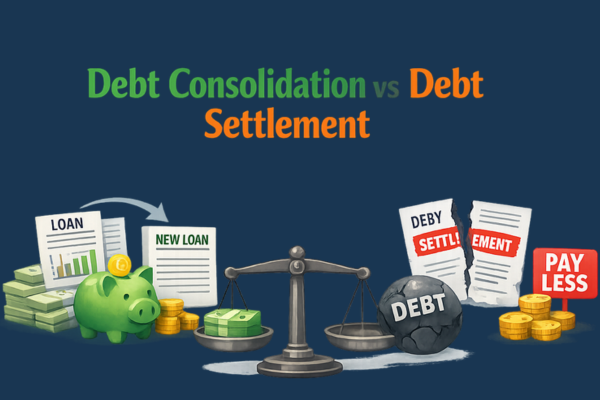
Debt consolidation and debt settlement are two different types of arrangements to eliminate insurmountable debt. Both have the potential to impact your credit score and financial situation. Understanding how both arrangements work and their alternatives will help you choose the right option for you.
What is debt consolidation?
Debt consolidation is the process of taking out a new loan to discharge short-term high-cost debts once and for all. The objective of debt consolidation in Ireland is to simplify monthly payments and save money on interest. It can help you become debt-free sooner.
How can you consolidate loans?
You will take out a personal loan to pay off existing short-term high-interest debts such as payday loans and other similar debts, which are required to be paid off in a lump sum. Personal loans charge lower interest rates than small emergency loans and offer structured repayment plans. You will pay down a fixed monthly instalment throughout the loan term, which cannot be beyond five years.
Bear in mind that personal loans do not include credit card debts. In order to settle the outstanding balance on multiple credit cards, you will have to apply for a balance transfer card. It offers low or 0% introductory APR, which lasts up to 21 months. If you settle the whole debt within the introductory period, you can avoid paying interest at standard rates.
Why do borrowers seek consolidation loans?
Debt consolidation loans in Ireland offer the following benefits:
- Potentially lower interest
If you manage to qualify for a personal loan or balance transfer card with lower interest rates, you will be able to save hundreds of Euros on interest payments. Since this reduces the size of the monthly payment, it provides your budget with some breathing space.
- Single payment
Consolidation clears all lump-sum loans once and for all, so you are left with only one monthly payment towards a personal loan.
- A fixed timeline
Personal loans and balance transfer cards come with a fixed timeline. You know when your total balance will be paid off.
What are the limitations of consolidation loans?
Before you consolidate debt in Ireland, you must know that:
- You will need to have a good credit score. Try applying for a consolidation loan or balance transfer card before you miss a payment. A good credit rating helps secure lower interest rates.
- Lenders are not obligated to combine all short-term high-interest debts. Despite consolidation, it is still likely that you have to deal with some debts separately. Most lenders do not consolidate above €1,000.
- Even if you have a stellar credit score, there is no guarantee that you will be able to qualify for lower interest rates.
- Consolidation cannot be a solution to your problem debt if you do not stop accumulating debt.
What is debt settlement?
Debt settlement in Ireland is a process of negotiating with your lenders to accept payments less than what you owe. A debt settlement company will negotiate with your lenders on your behalf. Your debt will be considered settled once you pay off the agreed amount.
What are the advantages of debt settlement?
Here are the advantages of debt settlement:
- It can help you save money
Since your lenders will agree to accept less than what you owe and mark your debt satisfied, it will help you save thousands of Euros. You can save this money to meet unexpected expenses down the line.
- You can avoid filing bankruptcy
Since debt settlement helps you settle your debts by paying less than what you owe, you can avoid filing bankruptcy.
- Stop collection calls
You do not have to face constant chasing from lenders after agreeing on the settled amount.
What are the challenges about debt settlement?
Do not throw caution to the wind while using debt settlement. There are consequences that you cannot avoid.
- Even if you pay off the agreed amount on time, debt settlement will be recorded on your credit file and will show you as a person with poor financial behaviour. As a result, your credit score will be damaged.
- Debt settlement companies charge fees between 15% and 25% of the original amount, which means the money you save by paying less could be consumed by fees. So, you might not save any money at all.
- It is vital to bear in mind that lenders are obligated to negotiate for a settlement. If you fail to bring your creditors around, you will need to consider other debt relief options.
Debt consolidation vs debt settlement – which is better?
Which of them is the right option comes down to your credit and financial health.
Debt consolidation is an ideal option when:
|
Debt settlement is an ideal option when:
|
What are the alternative ways to eliminate debt?
If debt consolidation and settlement do not seem to be an ideal option for you, you should consider the following methods:
| Debt avalanche
You will prioritise high-interest debts while paying the minimum due amount on other debts. This strategy is ideal when you want to save money on interest. |
Debt snowball
You will pay off the debts that are ordered from the smallest to the largest while paying off the minimum due amount on others, ideal for those seeking motivation. |
Debt management plan
You pay back what you owe by making monthly payments to a debt management company, which then distributes money among your creditors. |
The bottom line
Both debt consolidation and debt settlement help people to discharge debt, but they have their own terms and conditions and impact on your credit rating and financial condition. Whichever option you use, try exploring all alternatives.
FAQs
Is consolidation the same as refinancing?
No, they are absolutely different. Refinancing replaces an old debt with a new one at a lower interest rate while consolidation merges multiple debts into one.
Can I use my credit cards after transferring balance?
Yes, you can, but it is advised that you do not use your credit cards unless you settle the whole balance, because otherwise you will keep accumulating credit card debt.
How much do lenders charge in consolidation fees?
They typically charge between 1% and 5%. Compare fees charged by different lenders before applying for a consolidation loan.
Is debt settlement better than bankruptcy?
They are less damaging than insolvency but still harm your credit score. Debt settlement should be a last resort. First consider consolidation, avalanche and snowball methods.
How long does debt settlement stay on your credit report?
A debt settlement stays on your credit report for up to 7 years. After this time period, it automatically disappears from your credit report.

Ava is Editor-in-Chief at Givemyloan and is known for her deep and practical approach to modern personal finance. She has written several articles covering topics like personal loans, business loans, etc. Coming from an economics and finance background, she has worked behind the scenes to curate informative content to help borrowers identify the right loan option.
Ava’s role at Givemyloan lets her combine her interest in writing with her curiosity to explore the finance realm. She likes to be updated about what is happening in the lending industry. Most importantly, she tries to instil her knowledge in her writing in the best way possible.
She is passionate about helping borrowers look beyond the general features of a loan, i.e. about the fees and other intricate details. When she is not writing, she likes to read contemporary fiction. She is on a mission to help educate people looking for loans so that they take the right route.


