
What Can You Use an Unsecured Loan for in Ireland? 15 Common Reasons Explained
Most people in Ireland do not borrow because they want to. They borrow because something needs paying for now, and the savings account is not going to stretch that far.
That is the honest starting point for any conversation about unsecured loans in Ireland that borrowers actually apply for. The product is flexible. Almost too flexible, which is exactly why some applications go wrong.
So what are you allowed to spend the money on? And more usefully, what should you spend it on?
How does unsecured borrowing work in Ireland?
1. What does “unsecured” actually mean for you?
An unsecured loan is credit granted on your ability to repay rather than on an asset you pledge. No car logbook. No charge over your head.
The lender carries more risk, so three things follow:
- Interest rates sit higher than mortgage rates
- Loan terms are shorter, usually one to seven years, sometimes ten
- Approval leans heavily on income stability and repayment history
You still owe the money, obviously. Default leads to arrears, collections and a damaged credit file, so the absence of collateral is not the same as an absence of consequences.
2. What personal unsecured loans in Ireland cost right now?
Pricing has settled into a fairly predictable band for personal unsecured loans in Ireland. The CCPC puts the typical APR at roughly 7.5% to 14% for loans above €2,500, with bigger loans generally attracting a lower APR than smaller ones, and credit unions are legally capped at 12.68% APR.
Market examples from 2026 back that up:
- Bank of Ireland around 7.1% APR and AIB around 8.95% APR on a €30,000 loan over five years
- An average of 10.42% APR across credit unions affiliated to the Irish League of Credit Unions for a general personal loan
- Fixed rates from roughly 6.9% APR at the sharper end of the market
Worth knowing before you assume the credit union is dearer: 46% of ILCU-affiliated credit unions issued a loan interest rebate for the year ending 30 September 2024, averaging 3.7%. That quietly narrows the gap.
3. What do lenders check before saying yes?
Your stated purpose matters, but your file matters more. The Central Credit Register, run by the Central Bank of Ireland, holds information on loans of €500 or more, and lenders must request a credit report when the application is for €2,000 or more.
Missed payments do not vanish quickly either. Records stay for five years after the final payment on a loan.
You can pull your own report free of charge from the Central Credit Register before you apply. Very few people do it. Those who do tend to apply once rather than three times.
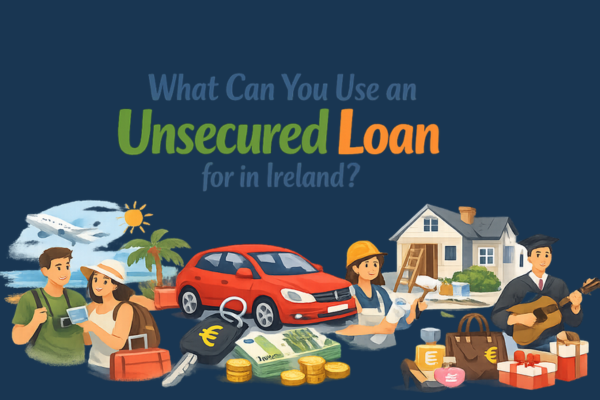
15 Common Reasons: What can unsecured loans be used for?
Reasons 1 to 5: Household spending that cannot wait
1. Buying a car. Still the single most common purpose. Credit union car loans averaged 7.7% APR on a €15,000 second-hand hybrid purchase, and a cash purchase often beats dealer PCP terms over the full cycle.
2. Home improvements. Extensions, new windows, a rewire. The average ILCU rate for a €20,000 home improvement loan came in at 7.22% APR.
3. Energy upgrades. Heat pumps, insulation and solar are frequently funded this way, often at discounted green rates.
4. Emergency repairs. A dead boiler in November is not a planning exercise. It is a Tuesday.
5. Furniture and appliances. Kitting out a first home without draining every euro of savings.
Reasons 6 to 10: Life events and personal goals
6. Weddings. Deposits land early, and suppliers want cleared funds, so the timing rarely matches the savings plan.
7. Education and course fees. Education loans averaged 6.7% APR on a €3,000 third-level loan repayable over three years.
8. Medical and dental treatment. Orthodontics, fertility treatment and elective procedures come up constantly.
9. Moving house. Deposits, removals, agency fees and the fortnight of overlapping rent nobody budgets for.
10. Holidays and travel. The CCPC lists holidays among standard personal loan uses, though this is the category where the analytical question below matters most.
Reasons 11 to 15: Debt, business and the unplanned
11. Debt consolidation. Folding several higher rate balances into one fixed repayment. Genuinely effective, provided the cards get closed afterwards.
12. Clearing a credit card balance. A card sitting near 20% APR replaced by a loan near 9% is straightforward mathematics.
13. Self-assessed tax bills. October brings a preliminary tax deadline that catches plenty of sole traders out.
14. Starting a small venture. Equipment, a van fit-out, and initial stock. Common where a business has no trading history yet.
15. Funeral and family costs. Not something people plan for and one of the quieter reasons behind unsecured borrowing Ireland-wide.
What Unsecured Loans Are Not Suitable For?
1. Routine living costs
If a loan is covering groceries, rent or utility bills, the problem is cash flow, not credit. Borrowing converts a monthly shortfall into a larger monthly shortfall.
2. Speculative investing
Crypto, shares, spread betting. The loan repayment is fixed and certain. The return is neither. That asymmetry is the whole argument.
3. Long-life assets on short-term credit
A twenty-year asset funded over three years creates a repayment burden out of proportion to the benefit. Secured or specialist finance usually fits better.
How to Judge Whether Your Reason Justifies the Loan?
1. The three-question test
Ask these before you sign anything:
- Does the spend hold value beyond the loan term, or at least deliver something the term is worth paying for?
- Could saving for six months achieve the same outcome without interest?
- Would the repayment survive a rise in rent, childcare or fuel costs?
Two ‘yeses’ and one ‘no’ are a workable position. Two nos is a signal to pause.
2. Compare total cost of credit, not the monthly figure
Stretching a term lowers the monthly repayment and raises the amount you hand over overall. Lenders quote both. Borrowers usually read one.
A €15,000 loan at 8% costs meaningfully more over seven years than over four, even though the seven-year version feels cheaper every month.
3. Read the small print on insurance and early repayment
Two practical points:
- Under the Central Bank’s Consumer Protection Code, a lender cannot offer you a pre-approved loan. If payment protection insurance is offered, its cost must be quoted separately from your loan repayment.
- Many variable-rate loans, credit union products especially, allow early clearance with no penalty. Fixed-rate products may not.
Warning: If you do not meet the repayments on your credit agreement, your account will go into arrears. This may affect your credit report and limit your ability to access credit in future.
Frequently Asked Questions
Does the lender need to know what the loan is for?
Yes, most ask. The stated purpose can affect the rate, since car loans, home improvement loans and green loans are often priced below a general personal loan.
What is the smallest unsecured loan available in Ireland?
Banks generally start around €2,500, while credit unions frequently lend smaller amounts to their members. Below that figure, an overdraft may work out cheaper.
Will applying damage my credit report?
An application leaves a footprint on your Central Credit Register file. One or two are unremarkable. Several inside a few weeks reads as financial pressure.
Can I use one unsecured loan to clear another?
Yes, and consolidation is a recognised purpose. Compare the total cost of credit on the new agreement against the remaining cost on the old ones before committing.
Are credit unions actually cheaper?
Sometimes. They are capped at 12.68% APR by law, and many pay interest rebates, though banks currently price larger loans lower. Membership is required before they will lend.
How quickly does money arrive?
Online applications with open banking verification are often approved inside 24 hours, with funds landing in one to three working days.

Ava is Editor-in-Chief at Givemyloan and is known for her deep and practical approach to modern personal finance. She has written several articles covering topics like personal loans, business loans, etc. Coming from an economics and finance background, she has worked behind the scenes to curate informative content to help borrowers identify the right loan option.
Ava’s role at Givemyloan lets her combine her interest in writing with her curiosity to explore the finance realm. She likes to be updated about what is happening in the lending industry. Most importantly, she tries to instil her knowledge in her writing in the best way possible.
She is passionate about helping borrowers look beyond the general features of a loan, i.e. about the fees and other intricate details. When she is not writing, she likes to read contemporary fiction. She is on a mission to help educate people looking for loans so that they take the right route.


